
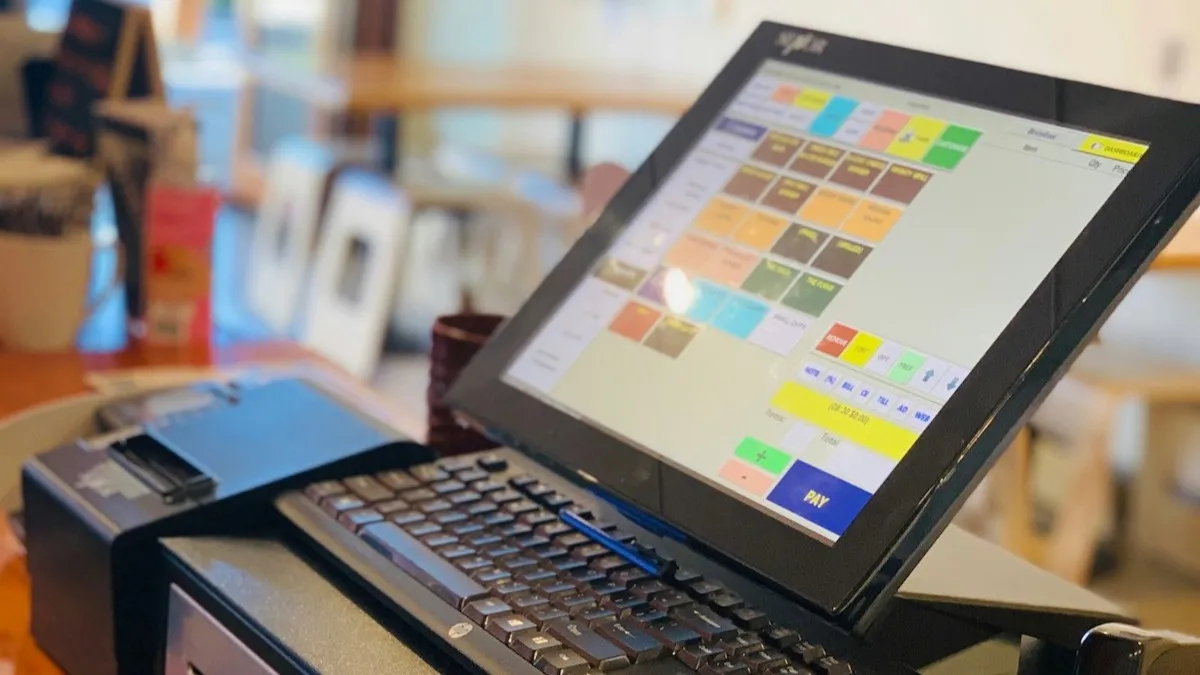
Zero blind spots. That's what restaurant software should give you in 2026: not just fast checkout, but control over inventory, purchasing, production, delivery, and electronic invoicing from a single place.
The Colombian market already has several mature options, but they're not all built for the same thing. Some are still counter POS systems with added features; others already think about multiple locations, AI applied to decisions, handling high order volume, real support when something fails at peak hour, and a cost that doesn't spike as the business grows.
We evaluated the three best restaurant software options in Colombia this year: Yuumi, Toteat, and Fudo. The question isn't which one has the longest feature list. It's which one supports the entire operation — from the register to the kitchen, from inventory to the DIAN — without the software cost growing faster than the business.
POS Selection Checklist
Compare your options point by point: price, AI, inventory, delivery, and support, before deciding.
Executive comparison
| Criteria | Yuumi | Toteat | Fudo |
|---|---|---|---|
| Price | Very competitive, from $100,000 COP/month | More expensive + % on sales | Mid-range |
| Handling high order volume | Very good | Very good | Very good |
| Multi-location / multi-brand / dark kitchen | Very strong — stock transfer between locations and its own production hub | Yes | Yes |
| AI for decisions | Yes, with native MCP integration | Analytics and reports | More management-oriented |
| Inventory optimization | AI + purchasing | Inventory and costs | Yes |
| Rappi | Yes | Yes | Yes |
| Didi Food | Yes | Depends on integration | Yes |
| DIAN e-invoicing | Yes | Yes | Yes |
| KDS / kitchen | Yes | Yes | Yes |
| Own store, no commission | Yes | Yes | Partial |
| Support | Yes, 7 days a week, minutes-level response | Yes, every day of the year + dedicated account manager on the corporate plan | Yes |
| Onboarding | Very fast | Medium | Fast |
| Cost to scale | Predictable | Rises with sales | Medium |
Yuumi: the top choice to scale
Yuumi is built exactly for this scenario. Plans start at $100,000 COP/month, with options by order volume and unlimited tiers, including unlimited users, registers, tables, and tickets, plus support for several points of sale.
The difference isn't the feature list. It's the automation:
- AI for inventory optimization and restocking suggestions.
- Recipes, sub-recipes, and production.
- Purchasing and expenses connected to real inventory.
- KDS, delivery hub, and reports.
- Online store and API/webhooks.
- Multi-location and multi-brand from a single dashboard, with stock transfers between locations and its own production hub for dark-kitchen operations.
What changes the game compared to the rest: Yuumi's AI is natively integrated with MCP (Model Context Protocol). That means the assistant doesn't just read dashboards — it acts on the business directly, connected to your operation's real tools and data instead of answering from static reports. It translates into simple questions that resolve business decisions: what to buy this week, which product is inflating your costs, where you have excess inventory, what you should produce today.
Yuumi integrates Rappi, iFood, and Didi directly into the order-to-kitchen flow, and electronic invoicing is connected straight to document submission to the DIAN.
Newsletter
Join the Yuumi newsletter
Guides, tips, and real cases for your restaurant — straight to your inbox, no spam.
When order volume grows, a POS that just charges is no longer enough: you need to control inventory, purchasing, production, delivery, and several locations from a single brain. Yuumi's architecture is built to handle high volume without losing control, with a cost structure that stays predictable as the business grows.
Toteat: the strongest competitor
Toteat is a mature offering, especially for medium and large operations. The advanced plan starts at $269,900/month plus 0.5% of net sales; the basic one, $139,900 plus 0.7%. The corporate tier has custom pricing.
For an operation handling high order volume, you're typically looking at the Advanced or Corporate plan, which includes KDS, inventory, recipe costing, delivery, pickup, API, multi-location reporting, transfers between branches, and, on the corporate plan, a dedicated account manager.
Toteat also integrates Rappi directly into the POS and kitchen, syncing menu and availability, and offers electronic invoicing aligned with the DIAN.
The problem shows up in the pricing model. At $100 million in monthly sales, the 0.5% is already an extra $500,000 a month, before taxes and the base price. For a growing chain, that variable cost starts to weigh right when predictability matters most.
Fudo: a solid third candidate
Fudo is a solid POS, with good regional presence and a specific focus on food service. It falls behind Yuumi and Toteat in this particular scenario, not because it's weak, but because the criteria that matter here — high volume, several locations, AI applied to decisions, and cost control — favor the platforms pushing hardest toward automation and predictive management.
The point that matters most: AI applied to decisions
Yuumi doesn't frame AI as an add-on chatbot. Being natively integrated with MCP, the assistant can query and act on the business's real data to directly answer questions like what to buy this week, which products are driving up cost, where there's excess inventory, or what's worth producing. For an operation with several locations, that's worth more than a dashboard with more charts.
Toteat has very good reporting, inventory, recipe, and cost tools, but its public offering leans more toward analytics and operational control than an assistant that recommends decisions.
Fudo is solid in management and analysis, but doesn't match Yuumi on AI applied to day-to-day operational decisions.
Rappi and Didi: critical for high order volume
When order volume is high, you don't want your cashier copying a Rappi order onto a tablet and re-typing it into the POS. You want the direct flow: the delivery platform enters the POS, moves to the kitchen through the KDS, gets invoiced, and deducts inventory automatically.
Yuumi integrates Rappi, iFood, and Didi natively. Toteat also has a direct Rappi integration and centralizes the order within its operational flow. In both cases, real delivery integration matters far more than having it as a secondary feature.
Support and onboarding
Yuumi offers support seven days a week, with responses in minutes, plus setup and training that can be completed in minutes. Toteat also provides support every day of the year and free monthly training sessions, adding a dedicated account manager on the corporate plan.
In short: Yuumi delivers closer, more agile support; Toteat offers a more corporate structure. For a growing chain, both are reasonable, but Yuumi's response speed matters when you have several locations operating at the same time.
Ranking: the 3 best restaurant software options in Colombia in 2026
- 🥇 Yuumi — 9/10. The best balance of cost and automation. Strong in AI with native MCP integration, inventory, delivery, own store, multi-location, costs, implementation speed, and predictable pricing from $100,000 COP/month. Create a free account
- Toteat — 8.4/10. Strong in multi-location, inventory, operations, delivery, APIs, support, and reporting. The 0.5% on sales plus the monthly fee starts to weigh as the restaurant grows.
- Fudo — 8.0/10. Viable, but less differentiated from Yuumi on AI applied to decisions and on high-volume, multi-location operations.
POS Selection Checklist
Compare your options point by point: price, AI, inventory, delivery, and support, before deciding.
The recommendation
For a Colombian restaurant looking to grow in 2026 — one or several locations, and especially if it handles high order volume — Yuumi is the option that makes the most sense. Not for having more features on a list, but for this combination: POS, delivery, inventory, recipes, purchasing, production, electronic invoicing, natively integrated AI with MCP, multi-location, and its own store, in a cost structure that stays low and predictable as the business scales.
The difference becomes critical when order volume grows fast. At that pace, an inventory mistake, a mistyped ticket, or a poorly planned purchase stops being a minor issue. That's where Yuumi's AI applied to inventory and purchasing is worth more than better reports: it helps you decide before the mistake happens.